Theory and methods
An EPR (electron paramagnetic resonance) spectrum detects precisely the unpaired electrons that every homolytic bond cleavage leaves behind. Beyond the mere presence of radicals, it carries a fingerprint of the chemical group that hosts each of them, because the resonance positions and the hyperfine pattern encode the magnetic environment of the unpaired electron. Reading this fingerprint requires two models:
A model that connects the spectrum to a small set of parameters, and those parameters to the electronic structure of a candidate radical (EPR parameters from first principles).
A model that turns a set of parameters back into a simulated spectrum (Numerical EPR spectra).
EPRoducer combines both models to decompose a measured spectrum into the spectra of candidate radicals (Decomposing EPR spectra with EPRoducer). The radicals that one expects in a sample thereby become hypotheses that the spectrum can confirm or reject. Since EPRoducer finds only radicals that belong to its candidates, Beyond the candidates: machine learning presents machine learning models that aim to derive the candidates from the spectrum itself.
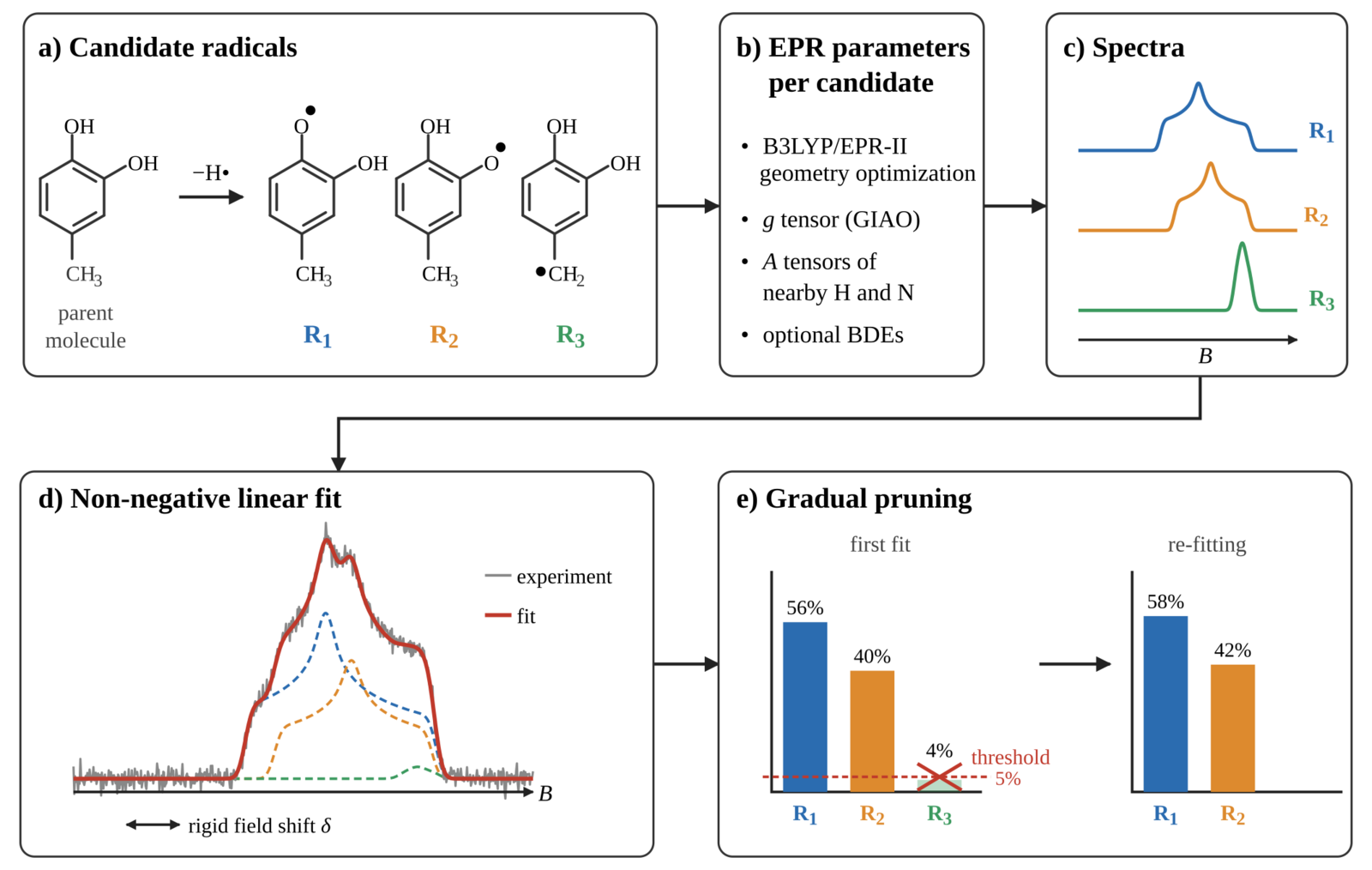
Workflow of EPRoducer. a) Each candidate radical results from removing one hydrogen atom from a reference molecule, here a model of the DOPA side chain that yields two phenoxyl radicals (R1, R2) and one benzylic radical (R3). b) ORCA computes the EPR parameters of every candidate. c) EasySpin simulates the solid-state powder spectrum of every candidate from these parameters. d) A non-negative linear combination of the simulated spectra, together with a rigid field shift \(\delta\), fits the experimental spectrum. e) A gradual pruning removes the candidates whose share falls below a threshold and refits the remaining ones. The spectra and weights are illustrative. See Decomposing EPR spectra with EPRoducer for the details.
In short
For the organic radicals that EPRoducer targets (\(S = 1/2\)), the spin Hamiltonian reduces to the \(g\) tensor, the hyperfine tensors and, for 14N, the quadrupole tensor. Linear response theory computes these parameters from DFT, which EPRoducer does with ORCA.
EasySpin turns the parameters into powder spectra, in which the low-field end, the maximum and the high-field end reveal the three principal \(g\) values.
Instead of adjusting the parameters of the spin Hamiltonian by trial and error, EPRoducer proposes candidate radicals, computes their parameters, simulates their spectra and decomposes the measured spectrum into a non-negative linear combination of them. A rigid field shift absorbs calibration offsets and a systematic error of the computed \(g\) values, and a gradual pruning leaves the smallest set of chemical moieties that explains the spectrum.
Since the fit varies only the weights, every parameter keeps a structural origin, and the weights estimate the share of each radical among the paramagnetic species of the sample. The decomposition, however, can only find the radicals that the candidate set contains.
Note
These pages are adapted from Chapter 3, Methods for Interpreting EPR Spectra, of the PhD thesis of Daniel Sucerquia, From Stretched Bonds to Radicals: Simulating and Detecting Mechanochemical Bond Cleavage (Heidelberg University). The cited works are listed in References.